2023 is upon us, and tis the season for prognostication. If I took a poll today, the glass-half-empty crowd would have the edge on 2023 predictions. And why not? Crises get clicks. Media talking-heads revel in an echo chamber of negativity. We can tune it out, sure. But the noise eventually influences behavior. Business leaders get overly risk averse. Some of them even join those talking-heads and, say, warn us not to buy new TVs. Such groupthink can make recessions a self-fulfilling prophecy (Thanks Bezos!).
TV purchase warnings aside, 2022 was a crazy year. We faced events that could have upended global economic stability — the potential for world war from an unprovoked Russian invasion of Ukraine; an energy crisis; heightened China-Taiwan tensions; another wild and bitter US election. These macro themes added to the preexisting business stressors of supply chain issues; inflation; interest rate hikes; a tight labor market; etc., etc. But good business leaders do not react with ostrich-like behavior. They analyze the world around them, assess the implications on their business, and adapt.
Below are our tips for project success in 2023.
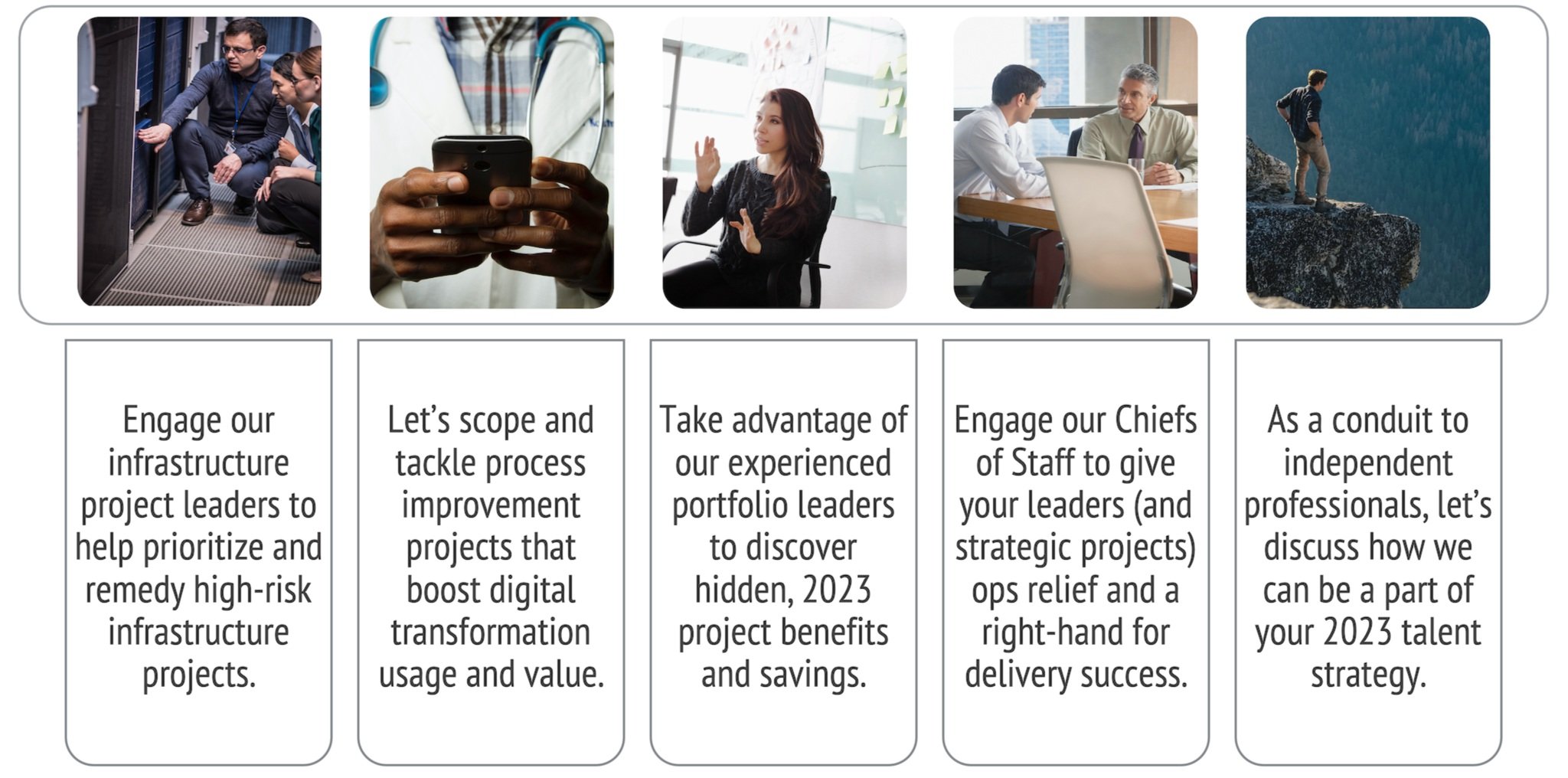
1. Prioritize and tackle your high-risk infrastructure projects

From an infrastructure perspective, 2022 had too many examples of “chickens coming home to roost.” Most recently and perhaps notably, Southwest Airlines’ scheduling software meltdown over the holidays snarled airline traffic and left a customer base seething. The cause? Years, nay, decades of deprioritizing software upgrades. Southwest became a poster child for how not to keep one’s IT house in order. Thankfully, their airline competitors got the message to modernize their own scheduling systems and infrastructure.
Economic uncertainties commonly lead to cuts to infrastructure projects. But the magnitude of these airline failures should be a fear-laden catalyst for prioritizing infrastructure replacement and modernization projects this year (e.g., system upgrades, cloud migrations, network equipment improvements, etc.). Even the Federal Aviation Administration is responding to their much-maligned infrastructure woes, “repairing and replacing key equipment in the air traffic control system, including power systems, navigation and weather equipment, and radar and surveillance systems across the country.”
Kicking the infrastructure can down the road is one thing, but the inevitable fallout can level an organization and eradicate its market share.
2. Bolster post-COVID digital investments

Two years removed from COVID, we are finding that reactionary investments in digital transformation were not mere stop-gaps for a stay-at-home workforce. Rather, such changes are now an ingrained and preferred experience, both for the customer and for the worker. Most notably is in Healthcare, where telemedicine has truly taken root.
During COVID, the demand for telemedicine surged. After two years, it has not declined. In fact, 72% of medical groups expect patient demand for telemedicine to increase this year (according to the Medical Group Management Association annual MGMA poll). [Side note: The MGMA believes there would be even greater demand if it were not for the infrastructure limitations in rural areas. I make this point in a nod to tip #1 above.] The popularity of telemedicine has led to medical offices reworking their daily operations and blocking telemedicine-only working hours for their administrators, nurses, and doctors. This change didn’t happen overnight, of course. It required new processes and a re-education of both worker and patient constituents alike.
Telemedicine is a microcosm of the maturation of digital transformation in our society. While enterprises have made their own post-COVID digital investments, many still struggle to infuse them into their daily business operations. This gap is a growing issue if customer and worker expectations for these tools are not being met. In 2023, we anticipate business leaders will bolster their technology investments over the last two years with business process design and integration projects, especially for services and product manufacturing.
3. Combine select projects to maximize their 2023 benefits

2023 will be a year of adapting to short-term turbulence and shake-ups in the competitor status quo. Business leaders achieve such adaptations by prioritizing and delivering projects. Project work, after all, is change work. It is adaptation in action.
It is an annual event (or should be) to evaluate one’s strategic project portfolio (i.e., evaluation of project priority, feasibility, and resource planning). With 2023 implying pull-back for select markets (especially in IT, which the Harvard Business Review describes as “sobering”), we can’t understate the importance of a portfolio review. “Separating real innovation from hot air can be the difference between a big win and a costly flop.”
In the HBR’s same article, they talk of “combinatorial trends” — i.e., an exploration of how a company’s investments “can create new possibilities when they’re used together.” This exploration is essentially a project portfolio exercise — a combinatory portfolio review, if you will. The goal is to find seemingly unrelated projects that together achieve greater benefit (and even cost-savings). The combination can then be grouped into new programs (i.e., strategically interrelated projects that are managed together) with new KPIs and benefits tracking.
While most project portfolios are already set by January 1, we highly encourage such reviews with recurring check-ins and re-evaluations throughout the year. We also recommend that they do not occur in a vacuum and take advantage of third-party, project portfolio experts. Such experts are objectively positioned to spot opportunities and benefits, which can sometimes be veiled by disorganization, departmental politics, and human biases.
4. Enlist Chiefs of Staff to relieve overburdened leaders

2022 was, according to Gartner, an agonizing “triple squeeze” of pressures: “inflation, scarce/costly talent, and disrupted/constrained global supplies.” On top of that, corporate leaders still were expected to build and manage high-performing, onsite/hybrid/remote teams; revamp business operations; maintain technical relevancy; and of course deliver positive outcomes that affect the bottom line. Post-2020 demands often seemed Sisyphean, a proverbial reference to Sisyphus, the character in Greek mythology whose eternal punishment is to roll a boulder up a steep hill.
What is becoming a more accepted source of expertise and relief is the business version of a Chief of Staff. Chiefs of staff are more common in military and government circles. But their purpose is equally relevant and valuable to executives, Lines of Business leaders, or project sponsors. Chiefs of staff can supervise and orchestrate communications with staff; serve as a stakeholder liaison; provide advisory services and consultation (ideally as a third party); can help drive projects; and more. The closest role comparison is a Program Manager, although Program Managers are rarely packaged with the Chief of staff label.
If 2023 is going to be a year of continued, Sisyphean-like pressure to succeed, then we recommend that leaders consider one of these Chief of Staff assets. Plus, the role can be utilized part-time, making it a luxury that businesses can likely afford in an uncertain year.
5. Bring independent professionals into your talent strategy

In last year’s version of this article, we cited a post-COVID rise in professionals exploring careers outside of traditional, employee-centric models (i.e., self-employment and independent contracting). According to the McKinsey’s American Opportunity Survey (AOS), that rise hasn’t subsided. Of the 164 million workers in the 2022 civilian workforce, 58 million are independent workers. Of that number, an estimated 10 million are consulting and knowledge workers. McKinsey characterizes this trend over the past couple years as “seismic”.
Despite the trends, many companies do not have a formal talent strategy for this growing base of independent professionals. This oversight may be caused by antiquated staffing preferences and preferred vendor lists that filter out the Independent Contractor. Another barrier may be risk aversion. This is common for large-scale corporations, who worry (often unnecessarily) that the independent contractor market cannot meet their insurance thresholds or carry enough indemnity protection.
Barriers and reservations aside, with recent talent shortages (especially in IT and supply chain), it seems foolhardy to eschew such a large segment of the US workforce. Companies should consider all resource options in 2023. Moreover, they need to revisit where each resource type is most effective and valuable (whether FTE, staffing, consulting, or independent professionals). For example, in the project management space, projects are an ideal use case for independent professionals, especially for projects that can be scaled in a tactical, short-term, fractional, and cost-savings way.
One final and subtle point: The independent economy attracts the most experienced and savvy professionals. An independent professional, with the legitimate skills and moxie to thrive in the wild west of freelance, has a talent profile that every company should seek in 2023.
****
In full disclosure, we passionately advocate for our independent economy and the Worker Sovereignty© that comes with it. After all, Mavendog is a conduit between the independent, project leadership workforce, and a client’s project needs.
Let’s approach 2023 together: