
Jon Vordermark shares his perspective project delivery services, and what has evolved over the last twenty years. It can be best classified as ‘commoditization’ of project resources. This article talks about the trade-offs of project delivery commoditization, the risks it can pose to project work and organizational competitiveness.

IN PART ONE of this article series, we touched on three catalysts that sparked a 20-year commoditization movement of project delivery leaders.

Large-scale companies pursue a large project portfolio year after year, and so there is a natural inclination for them to ‘do more with less’ and cut project delivery resource costs where possible. Large-scale companies are also in constant search of a magical formula that combats the unpredictability of project work.
In the wake of the 2002 and 2008 recessions, companies felt even more pressure to get a firm, corporate grip on project costs and volatility. Their answer/response was to shift to a weaker matrixed organization that depended on inexpensive, interchangeable project delivery resources. To achieve this end, large-scale companies:
- Shifted authority away from project leaders to internal departmental leaders;
- Layered more process controls on individual projects and portfolios;
- Downgraded leadership expectations of individual project resources;
- Leveraged Vendor Management Offices (VMOs) to limit professional service competition;
- Invested in expansive ‘Managed Services’ staffing for large labor pools (i.e., an ‘economy of scale’).
The long-term (twenty-year) side effect of their response, however, was a diminishment of the traditional project delivery leader. Granted, within these large-scale institutions, delivery staff still carry formal titles like ‘project manager’, ‘change manager’, ‘business analyst’. But they now operate with reduced authority, limited impact, and lowered expectations. Their project delivery resources are now, in essence, heavily commoditized.
From a talent acquisition perspective, commoditized resources create the illusion of an easy choice. They are something that can be easily defended on a balanced sheet (at least at first). They also offer a seemingly infinite supply of interchangeable alternatives (and project-failure scapegoats). But as we grasp the trade-offs of commoditization and start being honest with ourselves about what effective project delivery truly takes, this illusion quickly fades. There is no panacea to the unpredictability and volatility of project work. Instead it boils down to experience, specialization, leadership, and grit – qualities that can’t be commoditized.
In part two of this article series, we discuss the trade-offs of project delivery commoditization and the risks it can pose to project work and organizational competitiveness.
The Trade-Offs of Commoditization
Commoditized resources are known for being affordable and highly available, but they operate at a diminished impact and value. In other words, you ‘get what you pay for’. Companies that are attracted to the “savings” of commoditized offerings have to be ok with the tradeoffs. Primarily:

Moreover, Mavendog specialization is a fractional, rapid-response, gig-economy service — an alternative to traditional, full-time project personnel. Work can be ad hoc and deliverable-specific. It can fluctuate and be part-time, where commitments ebb and flow with a company’s ever-changing needs. In this time of intense client uncertainty, the flexibility of specialized, fractional project leadership is more valuable than ever.
Project stimulus efforts can include:

A Tradeoff in Leadership Expectations
Commoditized project roles are not leadership roles. They have to be more coordinative and administrative to stay in line with the low price thresholds of Functional, Weak, and Balanced Matrix models:
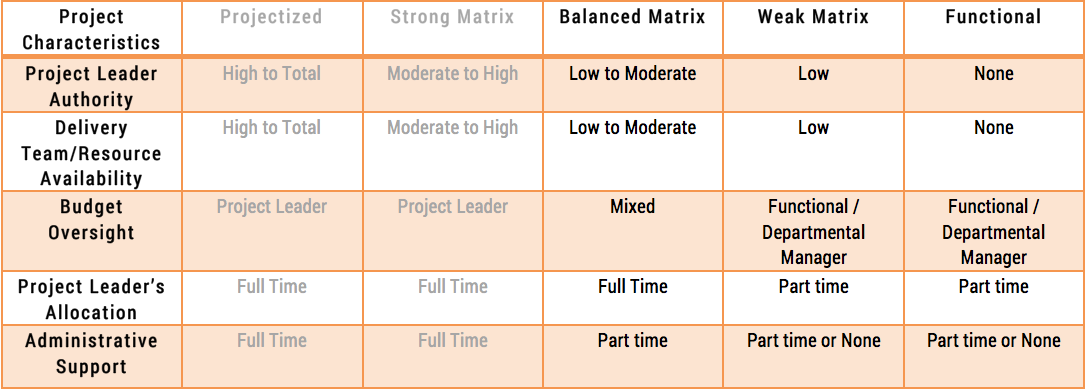
If an organization is operating under a weaker matrixed model, then it generally avoids assigning leadership authority to project managers. Functional and technical expertise is typically departmentalized, and projects get their oversight from departmental directors. What is ironic, however, is that many organizations operating in weaker matrixed environments still call for their project “leaders” to have advanced certifications as a prerequisite for a position. But such certifications can never be fully leveraged in weaker models.

A Tradeoff in Resource Quality
Commoditized project resources are generally less experienced and less impactful. It’s not a case that these resources are lacking; rather, it’s that they are typically junior-to-mid-level personnel; have limited industry, company, and project exposure and variety; and are products of their organizational institution/system.
To better enable a less experienced, easily replaceable, commoditized workforce, large-scale companies must invest in more project governance systems (custom methodologies, enterprise project software, rigid Project Management Offices, etc.). These controls are less about productivity as they are about monitoring performance and limiting damage. Again, commoditized resources are not project delivery experts, nor are they meant to be. They are component parts of an organizational system where compliance is the standard for delivery quality. And as I concluded part one of this article series, they are intended for only those specific organizational environments that can use (and insulate) them properly.

A Tradeoff in Career Opportunities
Organizations with weaker matrixed models limit career opportunities for project delivery leaders within the project delivery domain. For such delivery leaders, career advancement is via functional, technical, or operational departments (HR, IT Security, Finance and Accounting, and so on). But functional, technical, or operational leadership posts are very different from a purely project one. They do not have the kind of project focus that leads to expert/specialist status.
Organizations must understand that project work is a specialty unto itself and is something that is meant to transcend other domains. Those who have the intangibles of a project leader gravitate to challenges where they can hone their craft and take on greater and greater project-based responsibilities. Otherwise they must eventually leave the organization to advance. Ideally, they pursue organizations that value and leverage a ‘strong matrix’ model.

A Trade Off in Project Success
Commoditized project delivery resources are great if you have the capital to make it work. For large-scale buyers, they have a higher threshold for absorbing project failure. 30-to-40% of their annual project portfolio will fail, but the low cost/overhead of a large commoditized staff offsets the expense any anticipated losses. Most organizations (especially in the medium/middle market) do not have such risk tolerance. And even though the low price point of a commoditized resource is seductive, those organizations may be risking critical projects by putting them in the hands of someone less capable. And if the project begins to fail, the solution should not be to go back to the same well of indistinguishable, commoditized candidates.

A Tradeoff in Innovation
The shift to commoditized project delivery resources and weaker matrixed models was largely in response to 20 years of a challenged economic climate. It was a conservative strategy that allowed companies to weather the impact of two hard recessions. But even though the strategy makes sense in the short term, it can slowly stifle the very thing that makes project work so critical for an organization.
Growing economies mean a more active climate for innovation and change. Companies with the most experienced and unfettered project leaders (ideally in ‘Strong Matrix’ to ‘Projectized’ models) are better positioned to take advantage of positive economic conditions. These companies empower project and change managers to drive innovation for their organizations.
A Renaissance in Specialized Project Leadership
As innovative startups, disrupter companies, and middle market leaders are energized by a strong economy, we see greater interest in alternatives to conventional staffing firms, commoditized products, and conservative organizational models. For their make-it-or-break-it projects, those companies prefer project leaders.

This preference is starting to revitalize a specialist project delivery market that has been dormant since the dot.com boom. And to those within the project world, it feels like a renaissance – a rebirth of the service and a positioning of project management at the forefront of today’s economic surge. Projects work is the mechanism to achieve something new and innovative. It is the means by which a company drives through new frontiers and becomes (and stays) relevant in competitive markets. So more and more corporate leaders are recognizing (or remembering?) this original purpose project work and the proper expectations of its project leaders.
But renaissance or not, where do corporate leaders find non-commoditized project delivery specialists? Since the dot.com crash and the rise of project delivery commoditization, there has been a gradual talent exodus of project delivery leaders. The exodus may have been a bit hard to see at first. For example, in the consulting and contingent labor field, some firms tried to sidestep the commoditization by rebranding their project services. They would obfuscate the service under the guise of something like “Business Transformation” or “Advisory Services”. But even these pseudonyms were eventually subjected to Vendor Management Office (VMO) scrutiny and commoditization restraints. Today, however, specialized project delivery leaders are scattered. They’re typically found:
- Operating independently or via small boutique firms;
- Stuck in operational and functional leadership roles;
- Semi-retired, taking on ad-hoc projects that suit their interests.
To find and secure them, companies have to dig a little deeper into the marketplace. Also, they need to relax VMO restrictions in order to see a wider field of unconventional resources. But most importantly, they must re-think the chronic dependency on “easier” and “safer” commoditized options and the organizational models that have made it so pervasive. Otherwise even large-scale companies may find themselves idling towards lost market share and competitive stagnation.